hippity hop the Maslow 4.1 goes

Alternate titles:
tilt the Maslow 4.1 wilt
wheelie the Maslow 4.1 will surely

What am I missing here? I haven’t even cut any material yet; I’m just trying (in vain) to satisfy myself (before wasting material) that the Maslow 4.1 could cut something well.

FW is v1.15

I started with a 300mm/min feed rate (seen on this forum), and then halved it again for the provided video. The Maslow 4.1 sled hops/tilts around as it travels. Even if I slowed the feed rate further, it seems the added resistance of the router bit plowing through the material would make the phenomena present (or worse) all the same.
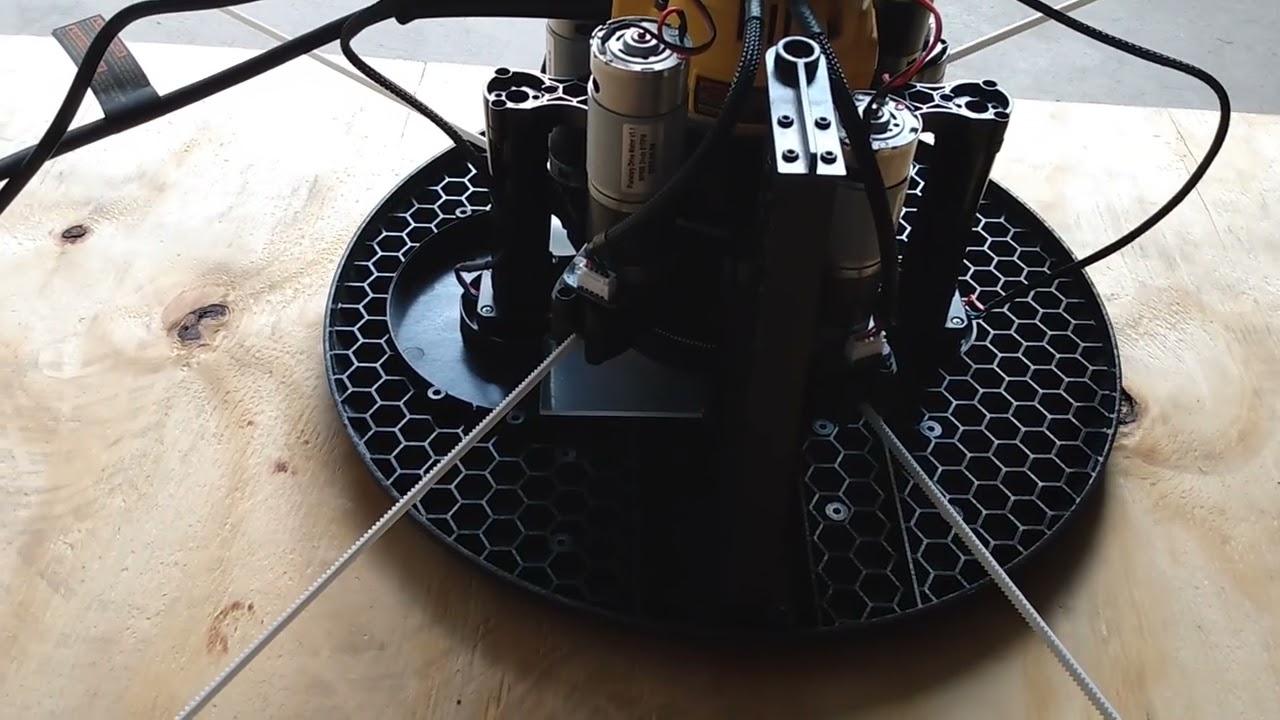
Perhaps the sled needs more weight, but I wasn’t under the impression that the 4.1 (particularly in horizontal mode) used bricks and it is not clear where they would mount securely. I could try decreasing tension, but the router bit movement would just take up the resultant slack and drive accuracy down further. I’ve seen one forum poster extolling the virtues of greasing the sled or otherwise reducing friction on the sled underside, but again, the router bit would surely act to tilt the sled and make a mockery of this, reduced friction or not.

My setup is a horizontal ~3000 mm H x ~3800 mm W on a concrete floor which I chose based on available space and the accuracy calculator showing nearly all green on a 4x8 sheet except the extreme corners.

Since I don’t have a router bit installed, I’ve homed the Z-axis by letting it travel as far down as it can go, and then backed it up 5mm (which could be a more rosy condition than when a router bit is installed and the router has be higher).

Here’s what the most recent 7x7 calibration (340 W x 170 H grid) reported:

Calibration values:
Fitness: 1.9773150552966041
Maslow_tlX: -12.3
Maslow_tlY: 2891.0
Maslow_trX: 3887.8
Maslow_trY: 2896.3
Maslow_blX: 0.0
Maslow_blY: 0.0
Maslow_brX: 3882.1
Maslow_brY: 0.0

Extend Distance is 2300, Retraction Force is 1300, and Calibration Force is 1000

It feels like the design depends on the belts acting on the fulcrum of a lever, whilst meanwhile the sled base and router bit have the mechanical advantage over the belts by being on the opposite side of that lever.

I presume it is not a coincidence that the hop/tilt is more egregious when heading towards the upper left, since upper left belt cog is highest and the lower left belt cog is lowest, providing increased torque for the assembly to tilt.

Would I be right in thinking that the earlier generations of Maslow had its chain mounted at the base of the sled (and at the same height) to reduce such forces?

Are your belt anchors raised or on the floor ? How high up are they?

In order to understand what is happening, can you put a copy of your maslow.yaml file and the full serial.log up here.
A few questions to help understand what is going on

  1. When you ran the Find Anchor did you have the Z right down?
  2. What is the minimum force needed to retract the belts.
    Reducing the retract force to the minimum consistent with reliable retraction is optimal.
  3. Are your belt anchors higher than the arms when Maslow Z is right down?
  4. Have you raised the belt anchors to match the arms (this is optional)?

Can you try Find Anchors with a 0x0 Calibration and set Width and Height to 0
Backup your Maslow.yaml file first!!

2x4logic wrote:

It feels like the design depends on the belts acting on the fulcrum of a
lever, whilst meanwhile the sled base and router bit have the mechanical
advantage over the belts by being on the opposite side of that lever.

I presume it is not a coincidence that the hop/tilt is more egregious when
heading towards the upper left, since upper left belt cog is highest and the
lower left belt cog is lowest, providing increased torque for the assembly to
tilt.

Would I be right in thinking that the earlier generations of Maslow had its
chain mounted at the base of the sled (and at the same height) to reduce such
forces?

the earlier version had the chains mounted at the same height on a ring to avoid
this, correct.

This looks like a combination of high belt tension and the sled not sliding
freely

if the anchors are not at the height the system thinks they are, it can cause
this sort of thing. That’s why the other two posters are asking about your
anchors.

David Lang

I’m a new user and the forum system informs me I cannot upload attachments.

Anchors are at the same height as the corresponding reel so that the belt is as level as possible. My intent was to cut some small PVC pipe of corresponding heights as spacers that would slip on the anchor bolts.

I can believe that trying to massage the belt tension might mask the most egregious behavior, but ultimately the belts are pulling at different heights and therefore will encourage the assembly to tilt.


The anchor points must be fixed, minor movements in of the anchor
bolt make a large difference, Some people have used 3d Printed stiffeners, others wooden blocks to prevent bolt from bending under pressure.
Anchor belt ends must also rotate easily
You will need to adjust the Z values to match the now level belts. The software compensates for the anchor points to be at the same height as the base and defaults to compensating for this with variable heights for each belt with the Z values (mine are level). Be sure you have put the arms on in the correct order if you decide to not raise the belt height or adjust the Z values to reflect what you have.
Reducing the force required to retract does minimise the fighting of the belts. This may require ensuring belts can rotate freely, but we try everything else first (Don’t want to pull arms apart).

I realize what you are saying is somewhat boiler plate, so obviously I orient the Maslow with the dust collection port on the bottom edge and put the arms in the correct location. The belt ends rotate freely.

Hmm… I was just reading a thread from Mar 2024 where bar was saying that 99.99% of users shouldn’t need to mess with the maslow.yaml file. That figure seems a bit optimistic. I was reading the thread vainly searching for DOCUMENTATION on what these values are supposed to mean so that I could change them intelligently.

The “tips” in the web page just say unhelpful things like “blah anchor Z (normally blah)”.

In this “You will need to adjust the Z values” procedure, would you please elaborate on what these Z quantities represent? Is it measured relative to the spoil surface or the cutting surface? Is the measurement from the base, center, or top of the belt ends? Does it need to be updated if the Z home position is updated?

As a broader observation, the current Maslow tutorial videos to market the product imply that the user just extends the belts, does a calibration, and everything is golden. To avoid annoying and turning away potential users, perhaps some sort of honest step-by-step procedure is desirable?

Thanks.

I think the issue here is that the machine is expecting the anchor points to be at the same height as the base of the machine.

It sounds like maybe you have each of your anchors at a different height which the software can handle, but it is going to lead to needing to mess with the .yaml files.

I 100% agree that there is a big need for a quick start guide. I’m working on one here but it’s targeted to firmware version 1.16 which isn’t out yet. Quick Start Guide | Maslow 4 Documentation

Generally making getting up and running quicker and easier is pretty much the main priority. Robots are hard, especially making them simple and easy to use.

1 Like