Best Customer Service Experience Ever
I had the best customer service experience with my Maslow 4.1 kit. I bought the 4 kit last year and then never took the time to put it together. When I finally found time to assemble everything over the holidays, I found that my .1 upgrade kit came with the RJ45 encoder PCBs while my control board had JST-XH connectors. I sent an email request on Friday evening and by 10am Monday morning, I had a response! Even better, the correct PCBs showed up only days later. @bar is awesome.
Putting the Machine Together
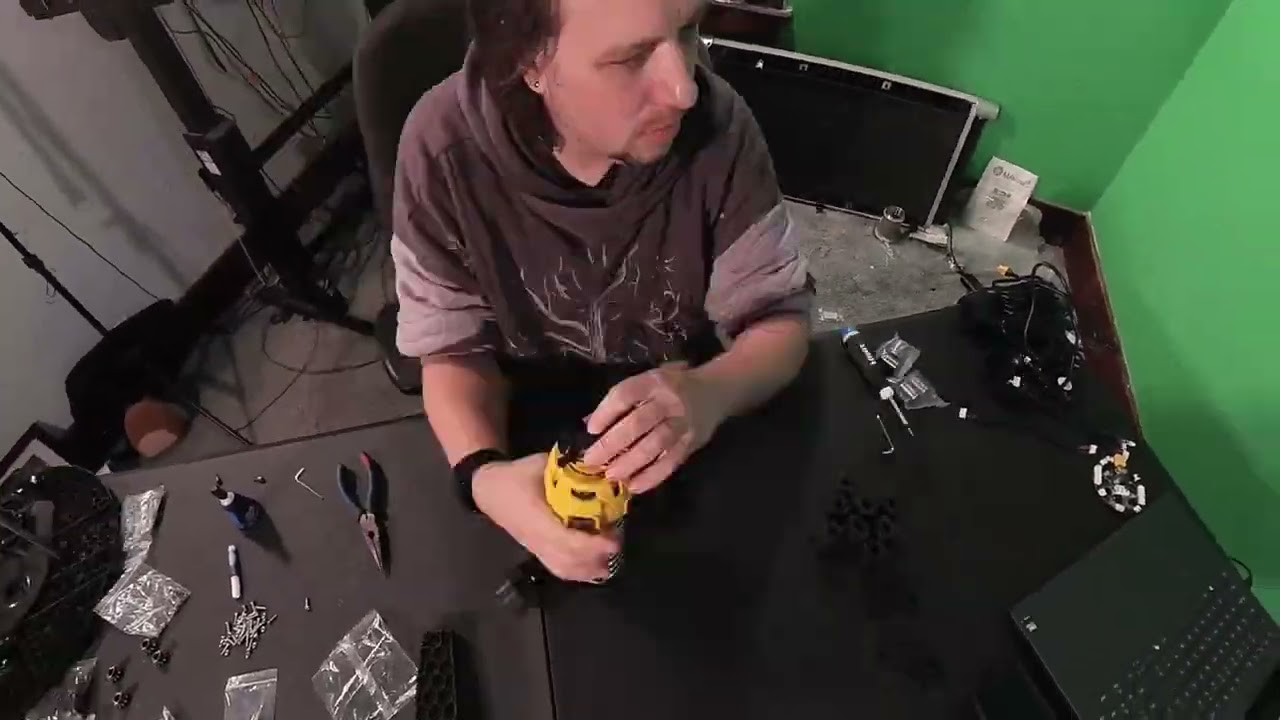
I began by Knolling everything on a folding table in my office and took my time putting everything together. I feel like it really helped to watch the YouTube video several times and review the pictures on Assembly Guide — Maslow very closely. Watch the following video if you wanna see some dumb idiot put the entire machine together and put the arms on upside-down… 
Creating a Default Frame
My garage is too small for a full-sized horizontal frame and although I have a large enough basement, I don’t want the Maslow to run there due to its noise and resulting dust. Therefore I opted for a “vertical” default frame.

We drilled holes at an angle through the upright 2x4s and added a homemade gate kit in both directions (offset by a foot so the cables would miss in the middle.) We also split the wood on the corner plates and so added additional 1/2" thick diagonal bracing. Even just freestanding, the frame is incredibly rigid! I purchased a small power strip and emergency stop and attached it to the left side. I also attached a few scrap pieces of wood to the bottom of the frame near the anchor bolts to protect my motorcycle tires when I wheel it past.
A tangent here: when I calibrated, I had trouble with one threaded rod for the Z-axis bottoming out before the other. A video of the issue is below. Can anyone help? Is it something to worry about?
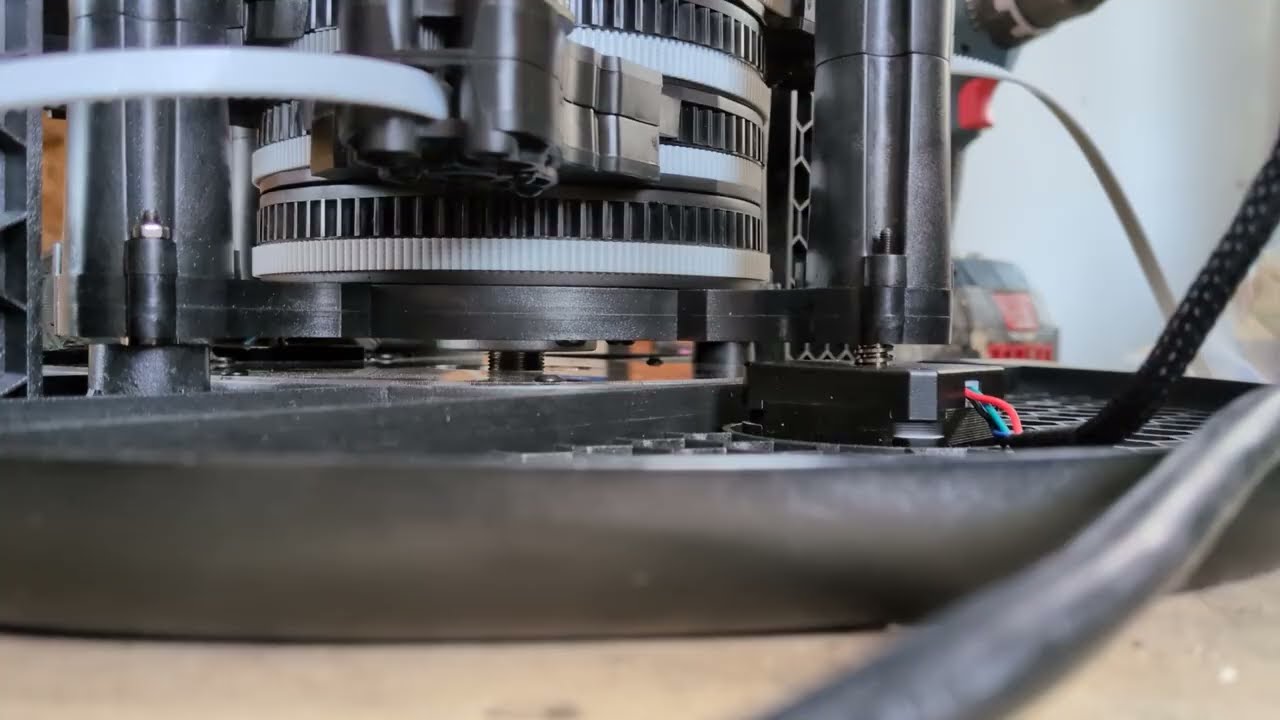
Another tangent: when I constructed the frame, I put in long threaded rod and multiple nuts locked together. The idea was to set each anchor point to match the Z-axis height of the respective arms. I lowered each anchor point though when I realized it might help alleviate the lifting of the sled in the corners. (I also gently and very carefully pushed the sled against the cutting surface while it was carving to keep it flush against the cutting surface.)
Design Choices
I didn’t want to just use a precreated test piece (like the Maslow logo) for my first cut. I wanted to be sure I could create something from conception to completion. Through my initial calibrations, I found it incredibly annoying to keep detaching and reattaching the Maslow for each retraction and recalibration attempt.
So I decided to design a flat-pack stool that would be tall enough to rest the Maslow on while attaching to the frame.
Constraints

- 3’ height overall will raise the Maslow to a more convenient Maslow pre-mounting height. But it makes for an unusually tall seat.
- 1/2" tabs will match the thickness of our medium. (I should have trusted my gut and measurements. The OSB was much thicker than nominal. It said it was .483"-actual but it was almost closer to 5/8".) I used OSB because I had an extra sheet and I wouldn’t mourn the cost too much if this project wasted it.
- 16" diameter seat will allow the entire Maslow sled to sit comfortably
- Interlocking with discs on the top & inside and interlocking with a ring on the outside will keep the legs from spreading apart. So I added an outer ring/footrest/step! (This was a mistake. We’ll discover that later.)
- 3 legged stools won’t wobble due to uneven lengths or uneven floor and will save weight and cut size so let’s design 3 legs. (This - combined with the footrest ring - was a mistake we’ll discover later.)
Designing in CAM Software
I love Blender and will try BlenderCAD or Blender CAD Sketcher eventually but I thought for my first project at least, I’d use FreeCAD or Fusion 360 personal so I wasn’t immediately deviating from an accepted workflow.
I didn’t have too much trouble designing my stool in either FreeCAD or Fusion.


I like that you can 3d model based off your sketches to sanity check your decisions and make sure that the parts “should” fit together.

(A note at this point: it should have been obvious just from the visualization above that the footrest ring and only 3 legs would be unstable. Imagine stepping on the ring on the right side to climb onto the seat.)
Planning the Cut
After exporting DXF files from the sketches, I added each to KrabzCAM to arrange. At first, I had them placed in such a way I’d only use about half of a 4’x8’ sheet.

But I didn’t want this first project to fail due to my ignorance re: the strength of OSB or inexperience setting a home near the edge of the sheet. (Would such a narrow area between the legs - even less with 1/4" kerf - be enough to support activity later in the cut?) I decided instead to be wastefully conservative for my first project.

I set values I felt confident about, added tabs, and exported the GCode. Please tell me what settings you would have changed.
To estimate how long the job would take, I copied the GCode into Nicolas Raynoud’s Q’n’dirty Toolpath SImulator:

To sanity check the job and the expected result, I opened the job in CAMotics, created a 1/4" tool, and simulated the cut:

Cutting
And then I couldn’t delay the inevitable any longer and started my first cut! I mounted the Maslow and turned it on and it said the previous calibration was invalid because of the TR arm angle. (It says this each time I restart the Maslow now I think.) So then I had to unmount the machine, retract the belts, extend the belts, mount it and recalibrate it again. I understand and love the calibration process but I’d love if you could tell it to use a previous result. (“Trust me. It’s the same frame.”)
And then it paused in the middle of the job and repeatedly plunged in and out. Does anyone know what causes this teabagging behavior? Is it a result of a wifi disconnect?
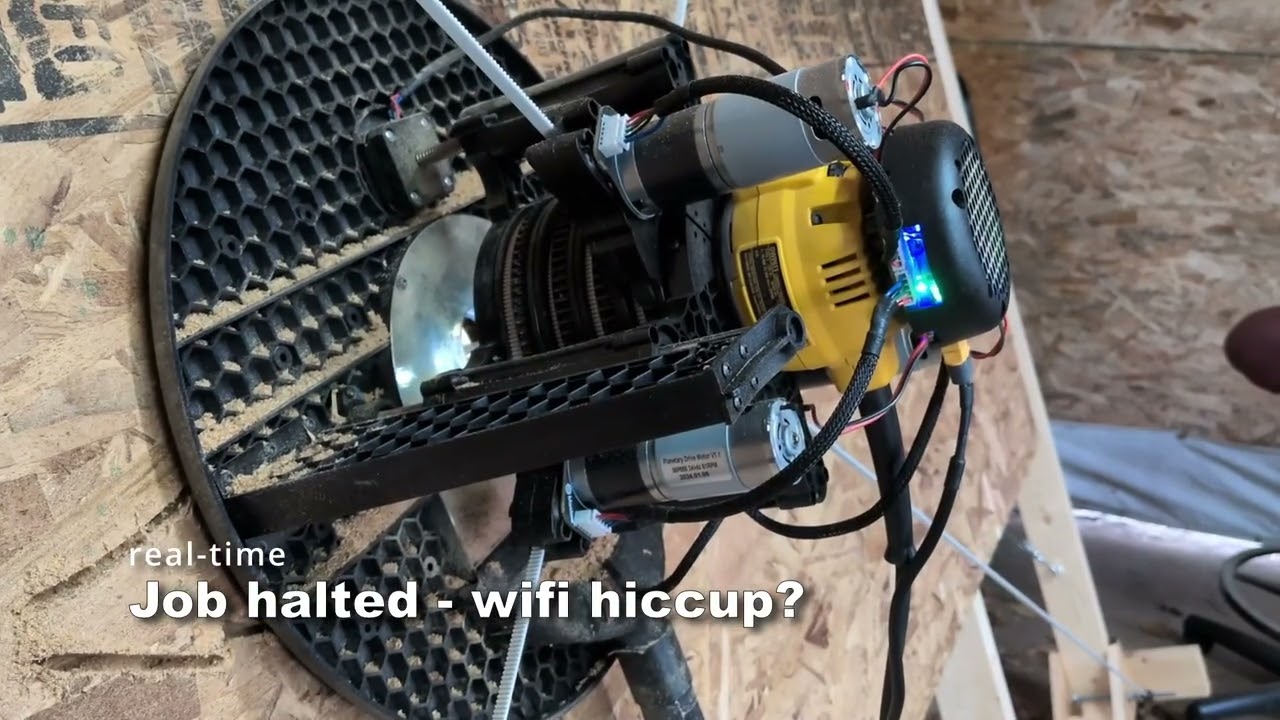
In the end, I cancelled the initial job (it cut only part-way through the third leg so I was going to have to finish it by hand) and recreate a job with the last 2 parts alone. Of course, I forgot to recreate the tabs when I made a toolpath the second time, so when it cut the inner disc, it fell and started spinning on the bit. I hit the emergency stop and knew I’d have additional cleanup on the incomplete ring part. (There was already going to be a lot of cleanup.)

Part Removal
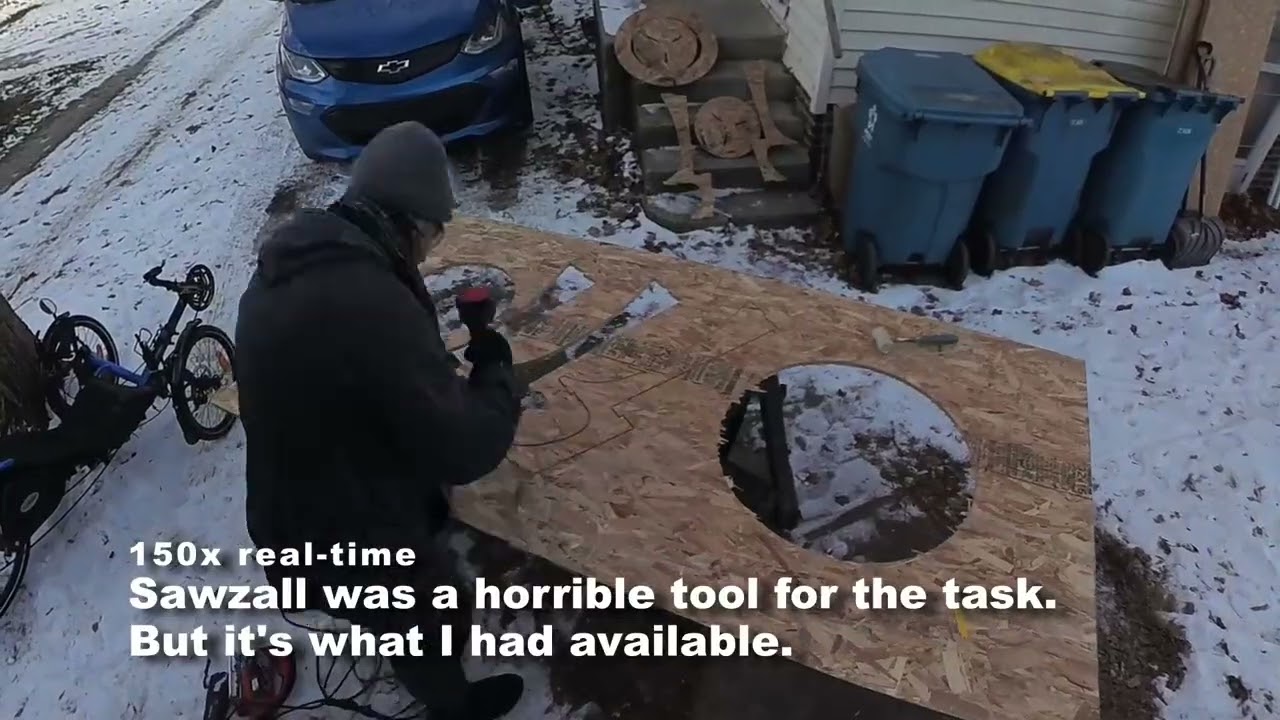
Removing the parts from the sheets was pretty annoying. This is a step I expect to improve greatly with more experience. I’ll have better material next time. I’ll carefully measure the actual thickness next time. I’ll babysit my laptop and the machine better next time (and probably tell my laptop to forget all its other wifi networks and never sleep.) And I’ll have sharp jigsaw blades, an oscillating saw, and a pull saw.
This time though I only had mismatched saw horses, a dull jigsaw blade, a sawzall, and an oscillating saw. It was cold enough my fingers hurt. And I had several parts that weren’t completely carved out.
Assembly
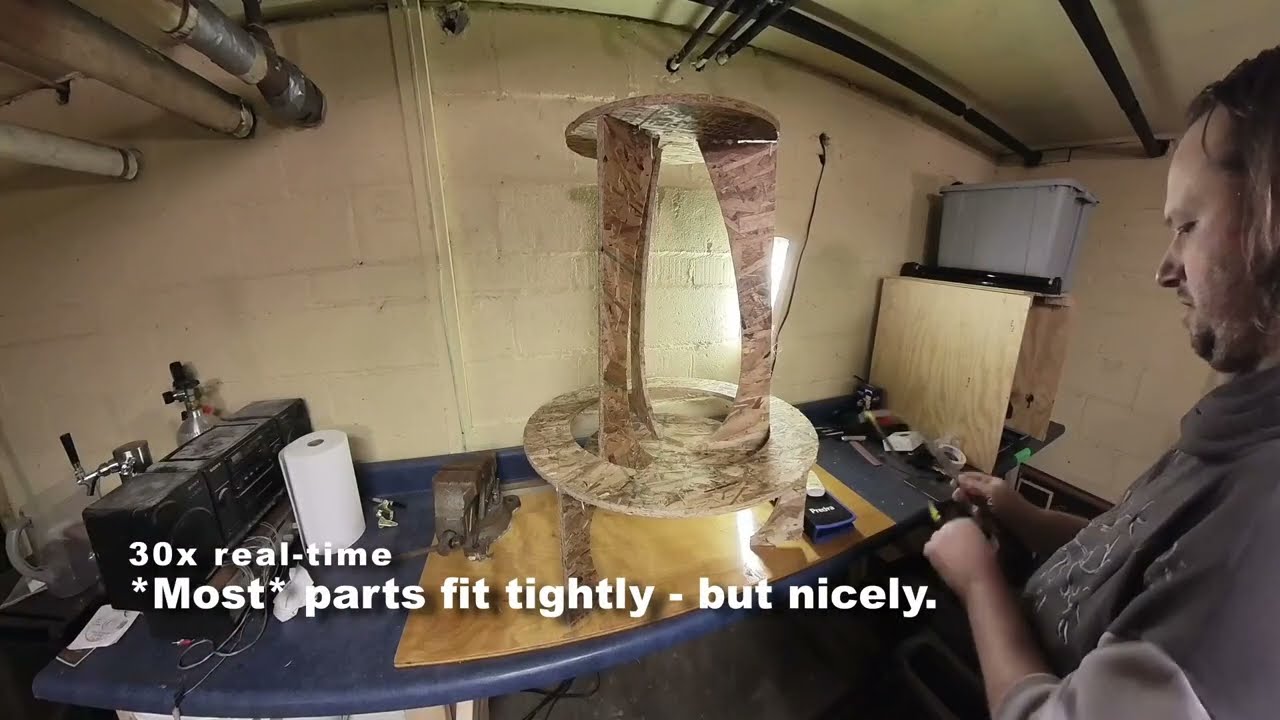
I brought the extracted parts to the warmth of the basement so that the wood glue I used would set and cure. I also used a vice and files to “smoosh” and sand the tabs closer to the nominal thickness. Then I used a soft mallet and eventually a sledge hammer to persuade the parts together. I spread wood glue by finger on all the tabs and the parts that would meet with the flat of the discs or ring.
The hand finished third leg was especially difficult.
First Cut Verdict
Except for the job not completing (and needing to be recalibrated even though it had already been calibrated on this frame) this machine is amazing! The difficulty in putting my stool together was due to trusting supposed material thickness over my measurements, and finishing by hand a part that was only partially cut by the Maslow.
And my design has a flaw. When you step on the ring to sit on the stool, too much of your weight is beyond the legs of the stool. I could have redesigned the ring (maybe made it triangular?) or given the stool 4 legs so less of the ring would extend beyond its footprint. 4 legs wouldn’t have even had to wobble. (https://youtu.be/47YbLU7-J1M)

I may add 3 additional legs at the halfway points between each current foot on the ring. I think a six legged stool sounds dumb but I’d like this first project to still be… sit-able.
In the meantime, I think it’ll work great for a Maslow pre-mounting stand! What do you think of my first Maslow project?

Project 2: A solo skin-on-frame canoe or sailboat!


(Just kidding. I’ll work up to those, I promise.)
